



The problem was never network detection. It was the distance between a good detection and a defensible conclusion.
ExtraHop RevealX sees what the network is actually doing. It produces high-fidelity detections and the evidence behind them — the devices, the communications, the behaviors — in real time, and at wire speed.
Then someone has to work them.
TENEX.ai partners with ExtraHop to Write the Standard for the Agentic SOC Alliance
That is where most network detection value quietly evaporates. Not in the quality of the signal, but in the distance between a good detection and a defensible conclusion. Analysts sample the queue because they can’t work through all of it. Evidence gets copied into a SIEM before anyone can reason over it. The investigative expertise that would make the call sits in a runbook or in one analyst’s head.
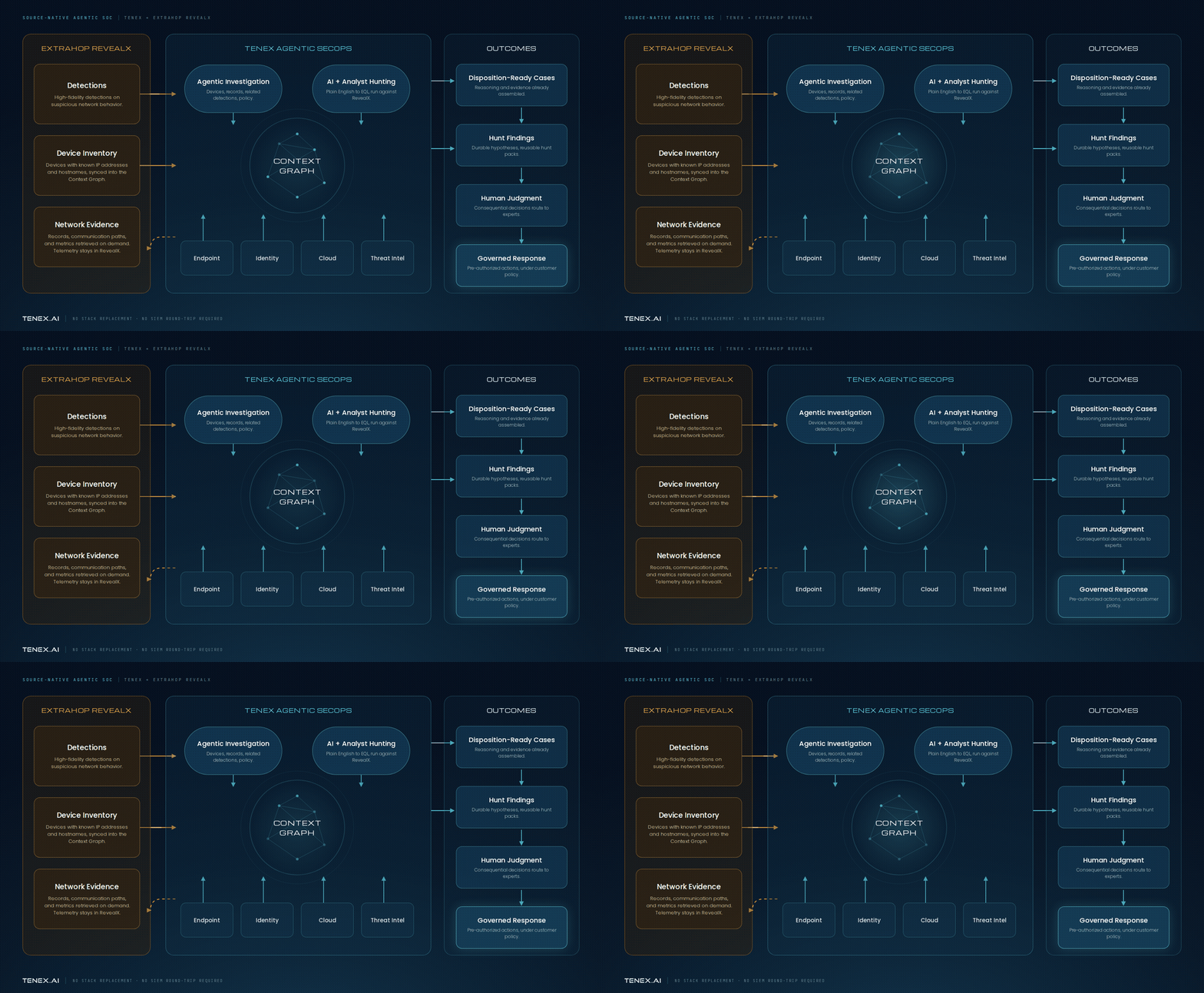
TENEX closes that gap. TENEX turns RevealX detections, based on real-time telemetry, into complete, disposition-ready investigations and proactively hunts them all within an agentic operating model where human experts remain accountable for the decisions that matter.
Outcome 1: Every detection investigated, not sampled
RevealX detections trigger complete investigations in TENEX.
Agents don’t summarize the alert or bolt on a few enrichment fields. They investigate by examining the devices involved, searching the underlying network records, identifying related detections, reconstructing nearby communications, and evaluating the behavior against your environment and operating policies.
Security teams can teach TENEX how to work specialized alert types in their environment, which questions to ask, what evidence to collect, what indicates benign behavior, and when human judgment is required. That expertise becomes part of every investigation instead of staying trapped in a runbook.
The outcome: a disposition-ready case with the reasoning and supporting evidence already assembled. Cases that require analyst judgment arise after the investigative work is done, not before. The network alert stops being another item in a queue and becomes the starting point of an investigation that begins immediately.
Outcome 2: Conclusions hold up, because they’re grounded in detailed context
TENEX synchronizes the RevealX device inventory into the TENEX Context Graph, linking devices to their known IP addresses and hostnames. When a detection arrives, agents know where its participants are located in the wider environment, rather than treating every address as an isolated string.
That supports two practical investigation modes:
- ExtraHop-led. TENEX agents investigate directly from RevealX detections and network context. No SIEM is required.
- Corroborated. TENEX agents test RevealX findings against available endpoint, identity, cloud, SIEM, threat intelligence, and historical evidence.
The distinction matters because the same network behavior means different things in different contexts. A connection to a rare external destination originates from a critical production server in one direction and from a test host in another. It changes again when it lines up with an identity event, an endpoint alert, a cloud configuration change, or a prior investigation.
The outcome: not “more enrichment,” but conclusions an analyst can defend and, when other telemetry is available, corroborate across sources without waiting for network records to land in a SIEM first.
Outcome 3: Finding what you went looking for
The integration turns RevealX into a hunting surface inside TENEX, for both analyst-directed and AI-driven hunts.
Analysts can query the data directly, write EQL, or state a hypothesis in plain English:
Find internal devices making repeated connections to the same rare external destination during the last 24 hours.
TENEX translates the request into EQL, validates it against supported RevealX record types and fields, and executes it against your configured ExtraHop environment. Analysts inspect matching records, review field statistics and AI-generated summaries, and refine with suggested queries.
When something is worth pursuing, the analyst elevates it to a durable hypothesis and conducts a structured, multi-step hunt. Each hunt preserves its query, execution history, findings, and analysis, and can be rerun across eligible ExtraHop-connected environments.
The outcome: governed hunt reports and reusable hunt packs. A hunt that worked once becomes a procedure the team can run again — proactive coverage that compounds rather than resets with every investigation.
Outcome 4: Routine work moves faster. Critical, auditable decisions stay with people.
Agents recommend and execute pre-authorized actions in accordance with your policies. Consequential, uncertain, or out-of-policy decisions route to human experts.
Every step is auditable: the context used, the queries executed, the evidence collected, and the reasoning behind the disposition.
The outcome: speed on the routine, human accountability on the consequential — and a record that shows which was which.
How it all comes together – the network, detections, and conclusions
RevealX remains the system of record for network data. TENEX retrieves focused evidence for each investigation and hunt and retains the investigative journey: the case record, findings, execution history, and the evidence pointers that justify the outcome.
High-volume telemetry doesn’t need to be duplicated to be useful. Organizations can make RevealX detections operational in TENEX without replacing their existing security stack and without routing every network record through a SIEM first.
That is what source-native means: the right agents, working with the right context, directly against the strongest available evidence — with humans accountable for the decisions that matter.
Look out for more on our partnership with ExtraHop and learn more about TENEX.ai and what a fully-agentic, human-led Security Operations platform can do for you.