
What We Learned Is Now Three New Extensions To The TENEX.AI Platform
Every security launch in 2026 comes with the same promise, and most of the time the promise is true as far as it goes. The new thing is faster than the old thing, it has AI in it, it gets alerts to analysts quicker than last year's version did, and there's a webinar. Faster is good. Faster also isn't the problem.
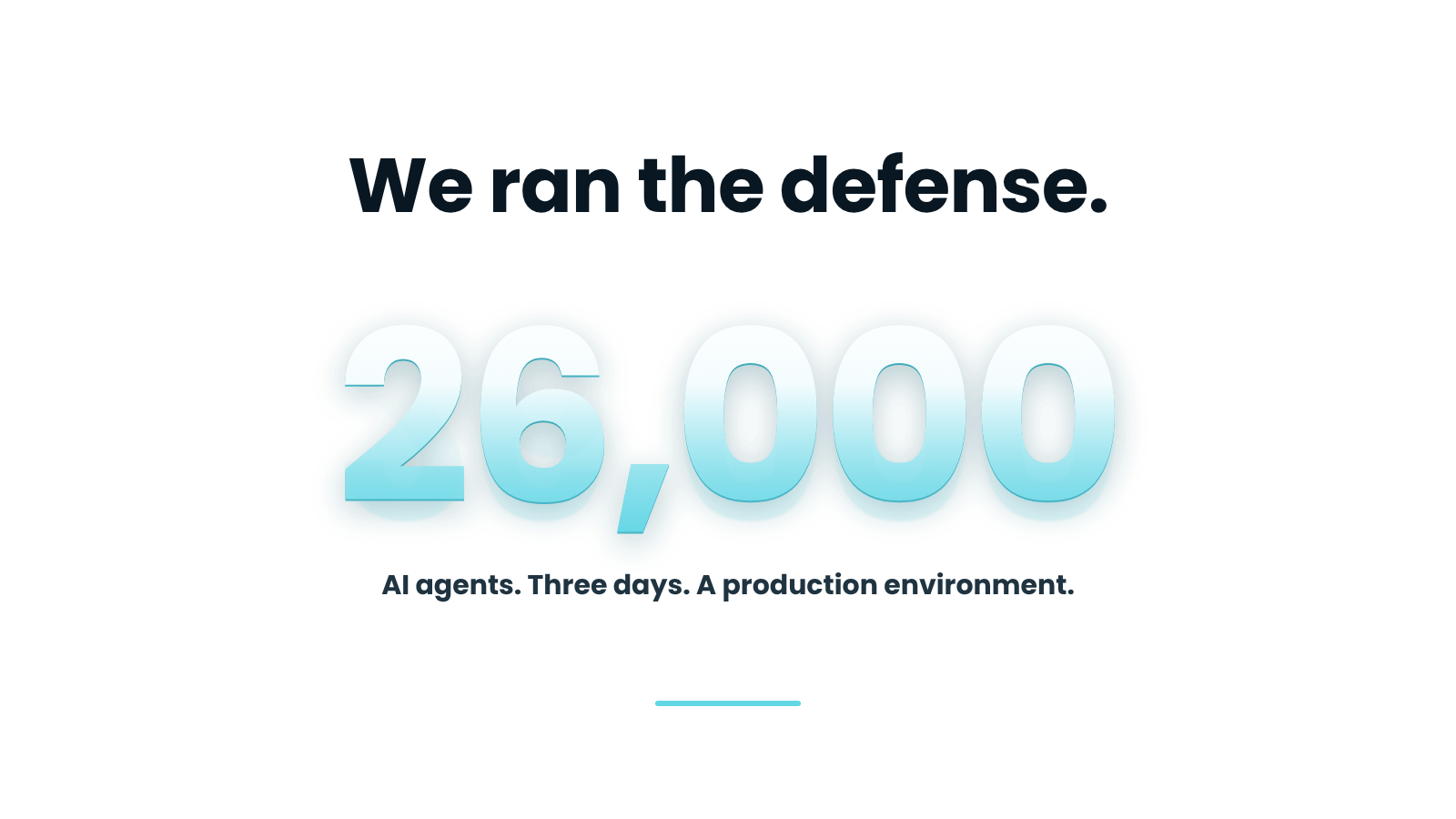
We know, because we ran the defense.
And even though our agentic security operations platform was able to defend at that time, we learned some things. Based on that, on November 11 we're opening a public preview of three extensions to the TENEX.AI Agentic Security Operations Platform: TENEX Telemetry, Alert Screen, and Threat Loop; and we're as proud of them as anyone ever is of a launch. But they didn't emerge from a roadmap; they came out of three days in July when TENEX.AI and our partner, Armadin, tested a full-scale attack with 26,000+ AI agents against a global institution's production environment while we defended it with our agentic secops platform. And once you've seen what that looks like from inside the SOC, the feature list is the least interesting part of what we're announcing.
What 26,000 Agents Look Like From Inside a SOC
Everyone says AI attacks are coming, and for a while that was reasonable, because nobody had run one against a real defense at real scale. So we did it with Armadin, Kevin Mandia's company, which builds agentic swarms that chain vulnerabilities the way attackers do. Their red swarm targeted a global institution with a mature SOC, in production, with zero knowledge and no credentials, and it worked like an attacker: it built a full petabyte-sized map of the environment, swarmed it in parallel, chained paths through controls, and adapted as it went. The target list grew to more than 25,000 hosts and services; the agents attempted 17 million actions in three days across billions of tokens. The only instruction on either side was to find the exploitable risk, with people governing both sides the whole way through.
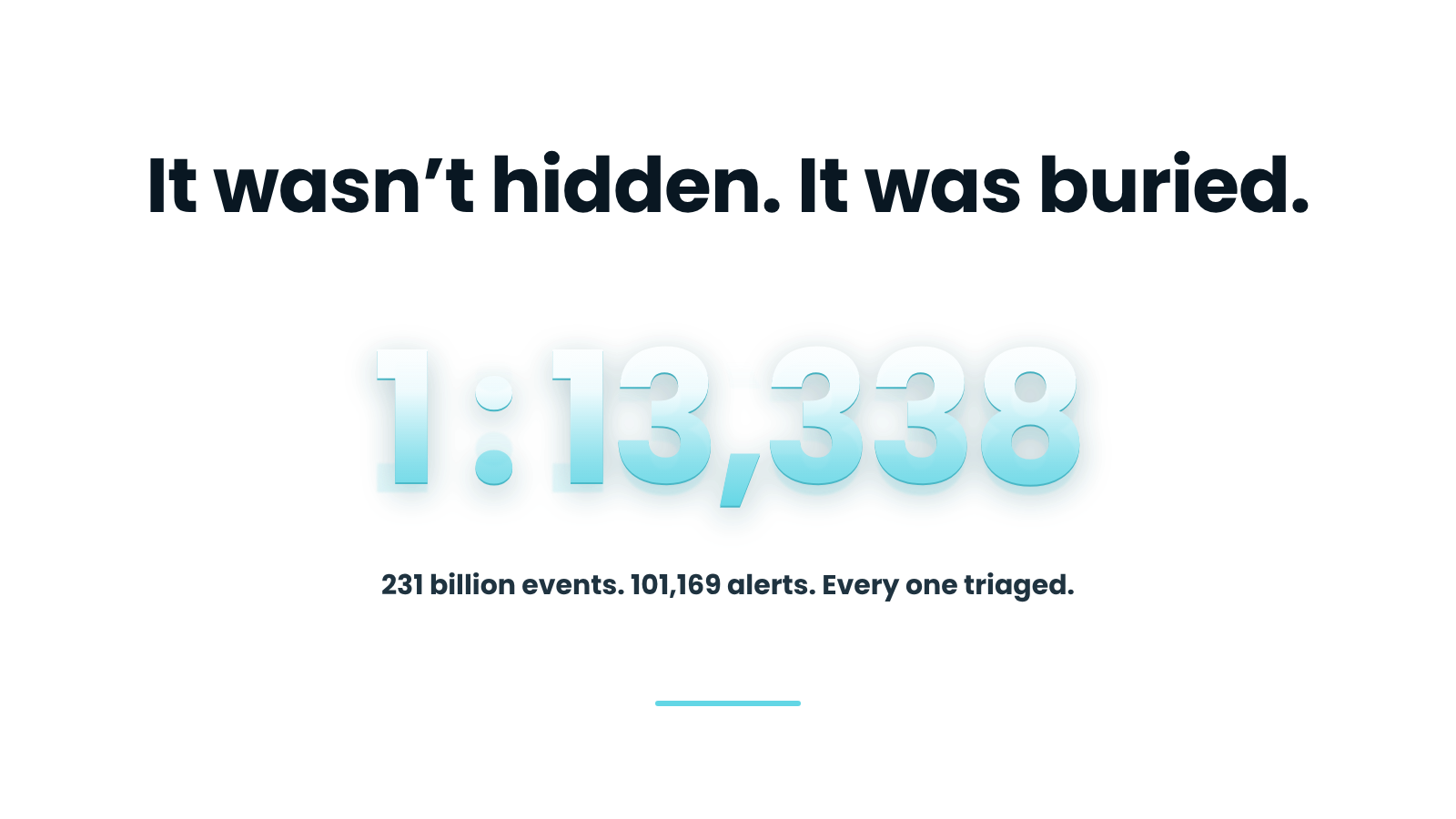
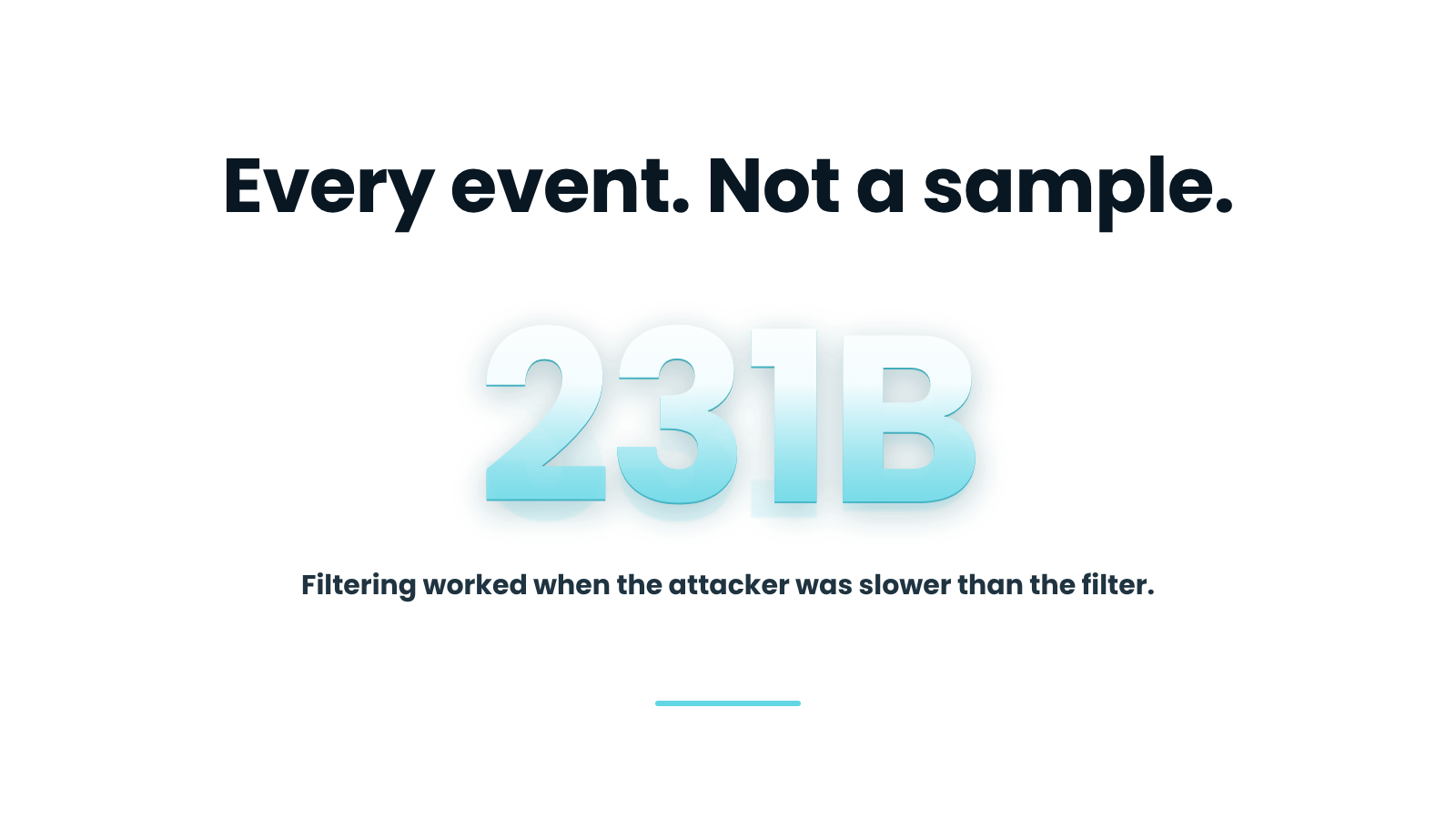
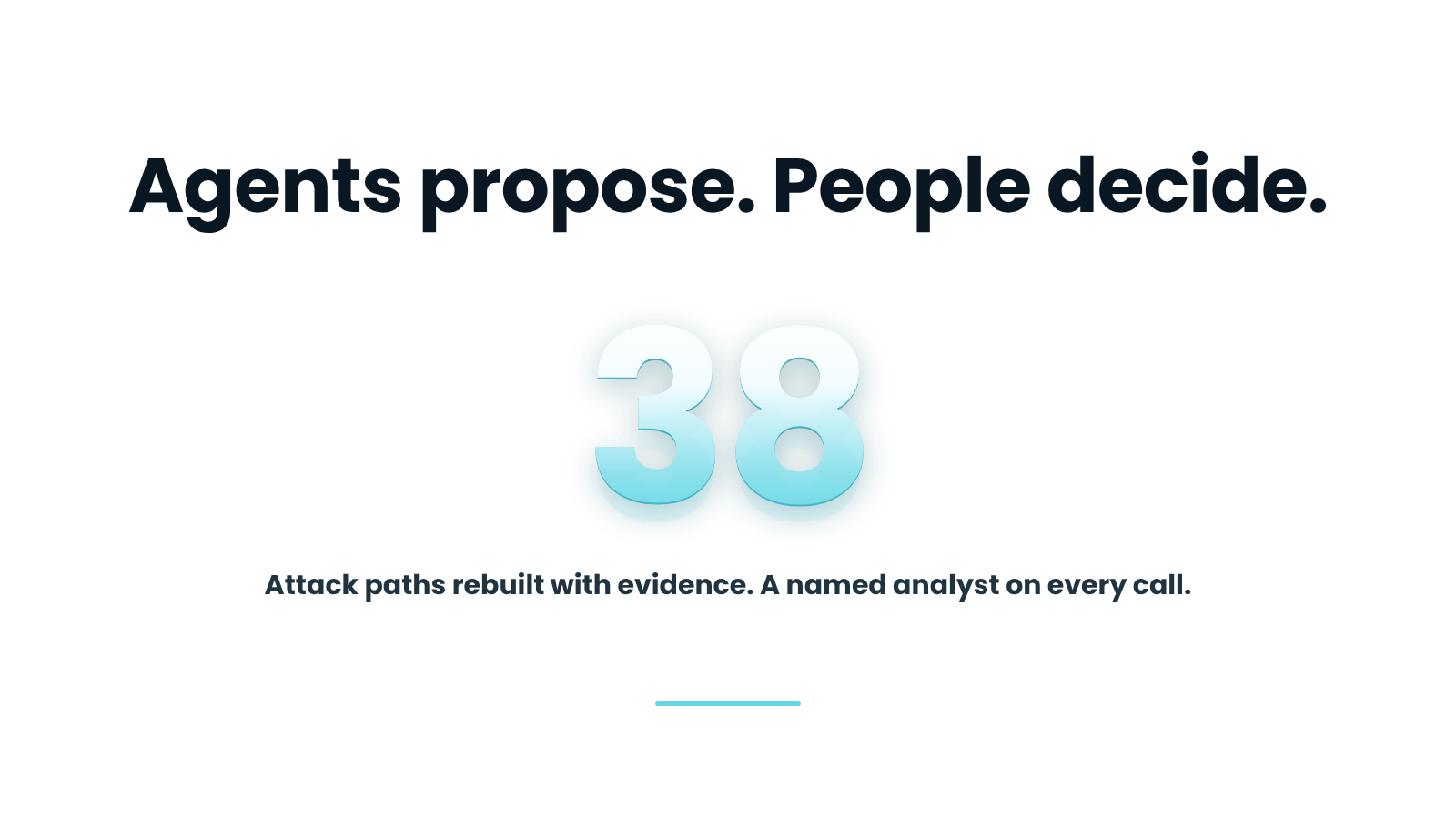
From the blue swarm's side, it came down to a few numbers. It's not even about the alerts; it's the scale. 231 billion events, and we watched every one of them, not a sample. 101,169 alerts, more than 33,000 a day, on top of what that SOC already handled, and we triaged every one. And in all of that, only one event in every 13,338 was the attacker. All 38 attack paths were detected, identified, then rebuilt with evidence, with a named analyst owning every consequential call. But here is the key: the attack wasn't hidden. It was buried.
You Can't Investigate Evidence You Never Collected
For thirty years, security operations has worked by filtering down: logs to alerts to triage to people, because that was the only way a human team could keep up, and every stage along the way drops volume and some of the context. That method worked when the attacker was slower than the filter, but it isn't anymore. Detections fired during the exercise and got lost in everything around them; much of the evidence we needed never reached the SIEM or became an alert because it sat in identity systems, network devices, and endpoints behind logging built for the speed people work at. Many of the exploitable exposures the swarm found weren't even CVEs; they were dependencies, libraries, and things with no alerts or logging attached. But they showed up in the attack graph, and the attacking agents could exploit them because they could literally attempt everything.
The practical lesson was simple: an attack like this goes after everything at once, so you have to look at everything close to real time, and no team can do that. So that’s what we’re previewing this week: hyperscale defense, with the required telemetry and the capacity to investigate it.
What We're Previewing on November 11
The telemetry you need, at machine speed, human-in-the-loop, hyperscale, on the SIEM you already run. That's the whole thing in one line, and it took making three new extensions generally available to get there. All three run on Google Cloud SecOps or Microsoft Sentinel, and those SIEMs stay as the system of record.
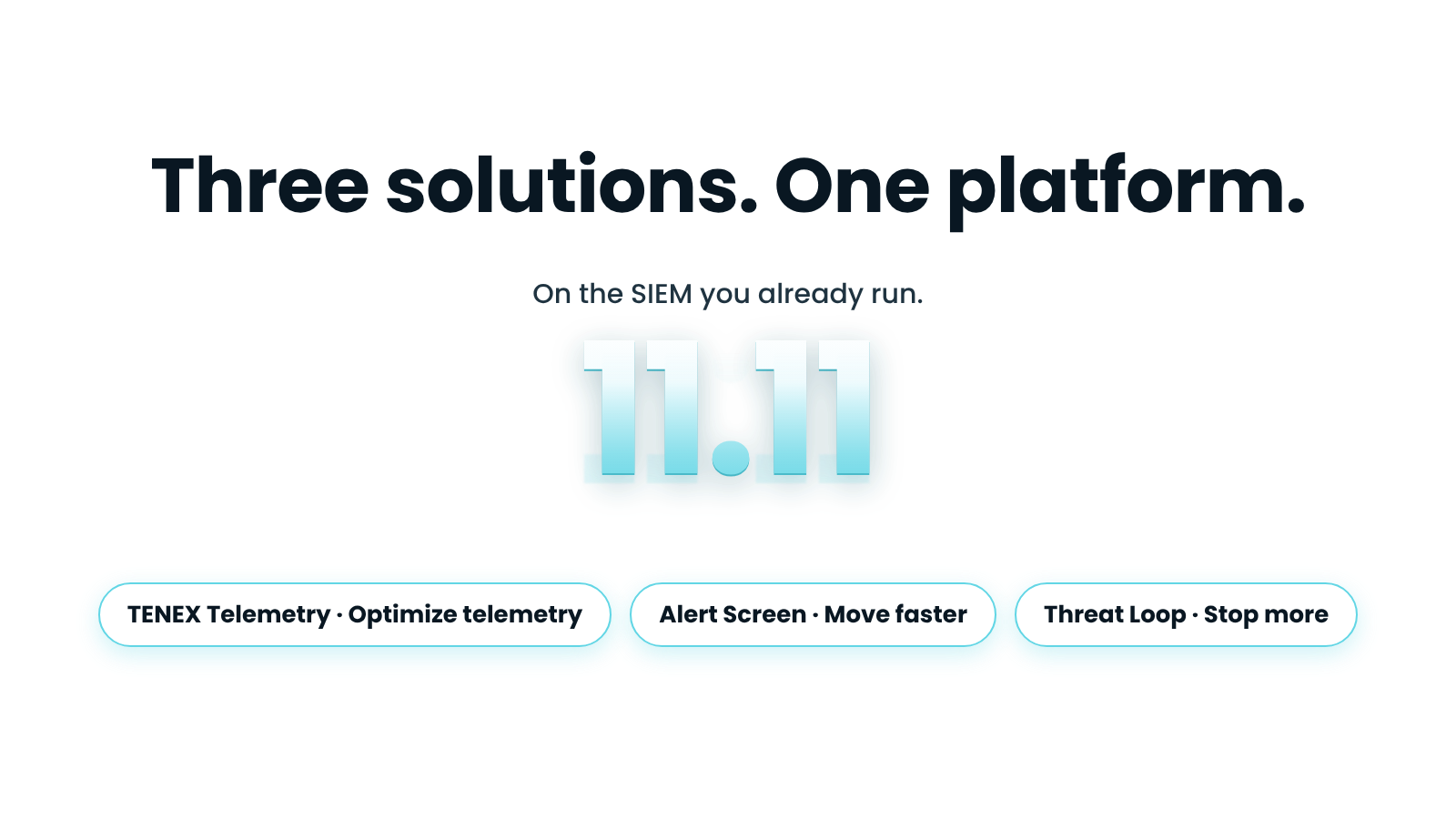
TENEX Telemetry: The first thing we’re announcing is TENEX Telemetry. This extends our platform to bring in everything the SOC couldn't see in July. It makes useful, missing, real-time telemetry available across your connected sources, choosing the right way to collect, query, and route data from each one and using it where it already lives; the principle behind it is the opposite of the filter: hyperscale defense needs everything it can get.
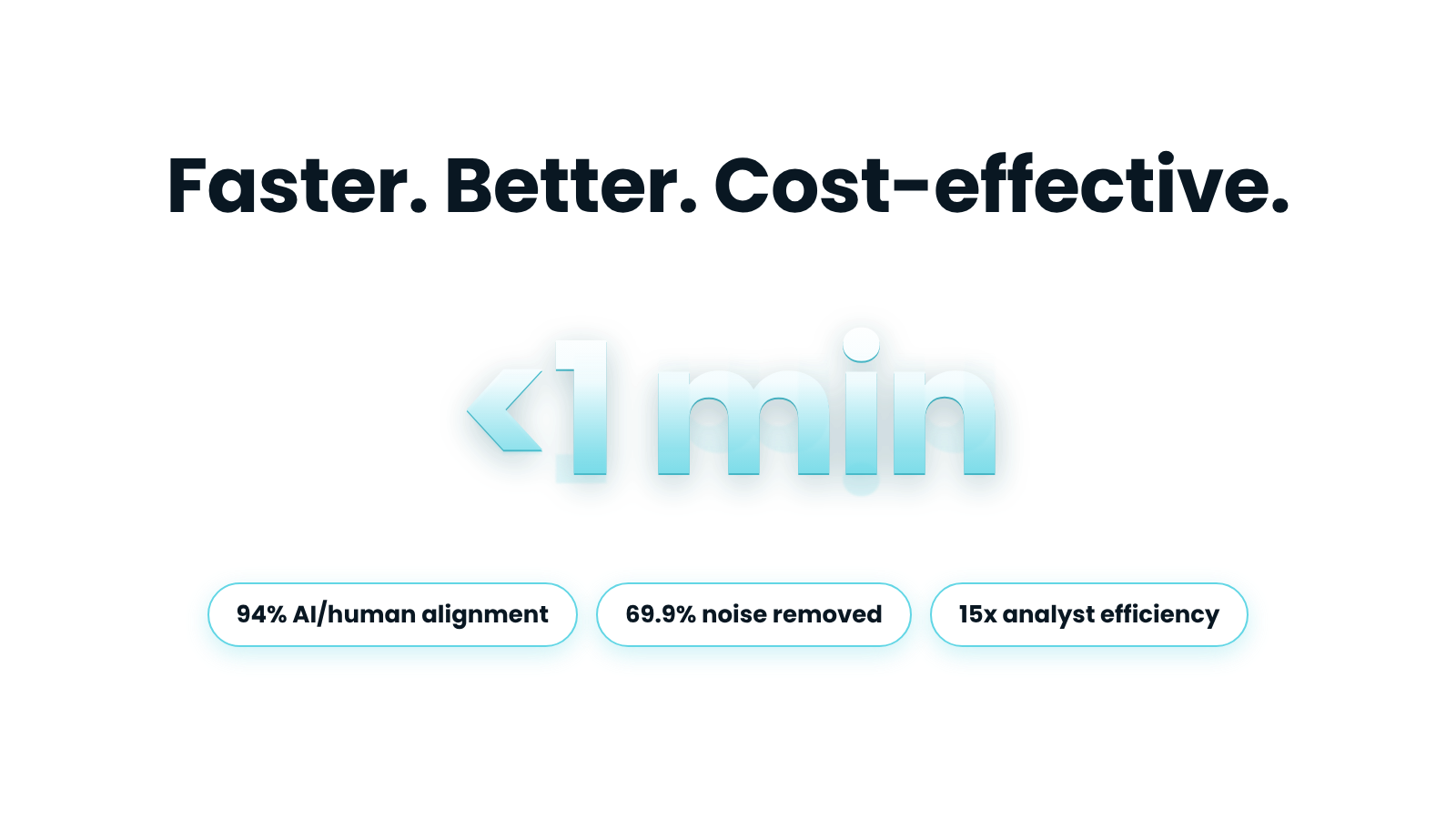
Alert Screen: Alert Screen, the second part that we will share, is the part that's live today, and it's where the volume goes. It produces evidence-backed verdicts with human oversight, with a median time to verdict under a minute, closes known noise with evidence under approved workflows, and hands the case to an analyst the moment the evidence runs out. A verdict is a verdict, not a claim that anything has been contained, and what happens next is governed by the response permissions the customer set. But the numbers behind it are measured, not projected. Over the last 90 days, July 29 to October 27, we achieved a median time to verdict under a minute; verified 94% AI and human expert alignment on outcomes; removed 69.9% of noise before an analyst ever saw it; and delivered 15x analyst efficiency, with the definitions published. Alert Screen now does this using the extended telemetry now available to it.
Threat Loop: And last, Threat Loop is how the lesson doesn't get forgotten. This extension of our platform automates the use of intelligence and analyst decisions to improve detection and response, hunting across the sources it can reach, including data already sitting in your existing tools, and feeding rules, detections, resolutions and new agents back into the platform, with a person testing and approving every new rule before it's enabled.
Today, we’re giving people a preview and early access to all three together. Alert Screen is live in production today. TENEX Telemetry and Threat Loop are with design partners and available to new customers now with full GA in the first half of 2027. The plan is for all of these to be available to any TENEX.AI Overwatch or Agentic MDR customer as part of our platform as it reaches general availability.
Nobody Talks About What It Costs to Defend
Every breach write-up tells you what the attack cost the victim, but almost none tell you what it cost to defend. For the attacker, the cost of each extra attempt keeps falling. With each new release, the commoditization of attack functionality is already being duplicated in even the most general open-source models. As a result, the attack we defended against in October will cost less to run next year than it did this year, and less again the year after. As the cost of staging the kind of attack we tested diminishes, nobody is too small, too obscure, or too well-defended to attempt. For the defender, the cost runs the other way, because agentic security operations means paying for inference on alerts, continuously. “Gartner predicts AI inference costs per agentic workflow will increase more than fivefold through 2028,” according to their August press release (https://www.gartner.com/en/newsroom/press-releases/2026-08-17-gartner-predicts-ai-inference-costs-per-agentic-workflow-will-increase-more-than-fivefold-through-2028). And as we say, you can't filter your way out of that, because the evidence you drop is evidence the attacker can hide in.
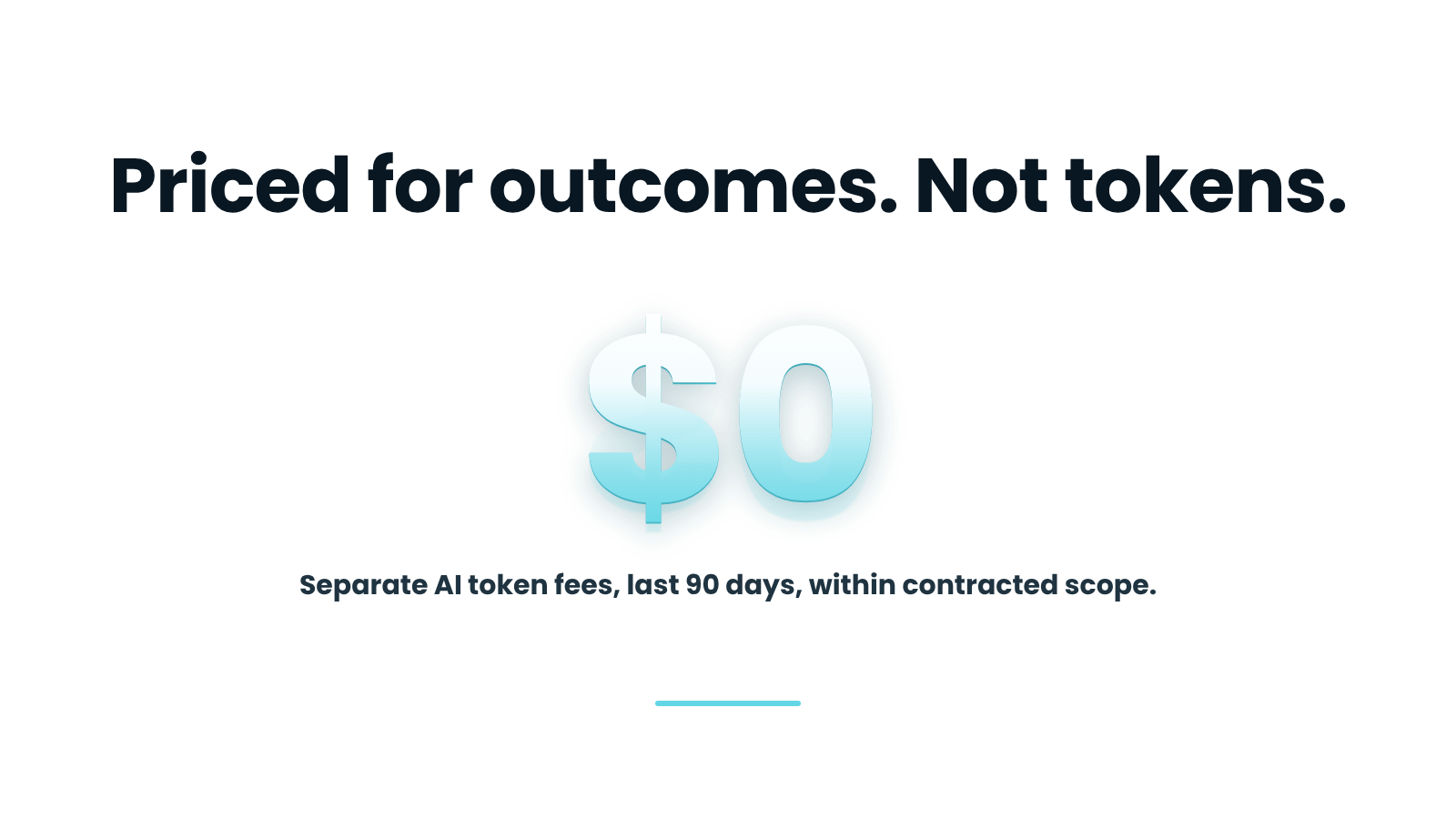
Much of what we built into Alert Screen and Threat Loop is based on this. Token consumption has to earn its keep, and the cost of defending shouldn't need to scale linearly with the attacker's volume. At scale, with access to the missing telemetry and context, specialized agents group routine investigations or run lean, task-tailored models. Frontier AI is optimized for the threats that need it; it assembles context once and reuses it. That’s also how TENEX.AI can price for outcomes instead of raw token volume. Over the last 90 days, we've charged $0 in separate TENEX.AI token fees within the contracted scope. The cost of looking at everything is ours, not yours, and that isn't a discount we're offering for the preview; it's how the platform was designed from the start.
The Models Change. The Governance Doesn't.
Models keep changing and the rules for using them can't, so production versions are pinned, and upgrades are deliberate: new models get tested against cases we already know the right answer to and against our senior analysts, changes go live with a record of what was tested and why, and every generation gets retested against the latest AI-driven attack. Architecture matters: you have to build from the beginning so you can inspect every verdict, audit every step, and, when the evidence runs out, route the call to a person. That is the only way accountability survives at this scale. Agents propose. People decide. We've said that since launch, and this exercise proves it holds at scale: even before we launched these new solutions, our agents absorbed the volume, and exceptional humans owned every decision that mattered. The agents did the work in July, and the people owned the calls, and that order doesn't change when the volume does.
“We ran a live AI Hyperattack with Armadin because opinions don't defend anything. We learned it's not the alerts; it's the scale. One event in 13,338 was the attacker, and it wasn't hidden; it was buried, and you can't filter your way out of that. So we built for it, and because investigating every alert costs compute, we made that cost ours and not our customers'. Agents do the work. People own the calls.”
— Eric Foster, Founder and CEO, TENEX.AI
Why We Did It in Production
There's an easier version of this exercise, and it happens on a range nobody runs a business on: a swarm told where to look, with tidy results. We didn't want tidy. If fully agentic, human-led security operations can't hold up in a live environment that real people depend on, with a real SOC watching and a swarm that doesn't care what it breaks, then it doesn't deserve the claim, and we'd rather find that out ourselves than hear it from a customer. It held. A swarm test on its own tells you you're exposed. A swarm defense on its own is a claim. Put them together and “are we ready?” becomes a number with an owner, and that's the difference between a demo and fully agentic defense.
Venkata Koppaka, our co-founder, spent years on the founding engineering team behind Google’s core SecOps stack before building this, and he covers it in his keynote. If you want to know whether your SOC would have seen all 38, that’s where you find out.
Your take-home
Eight questions, one copy per SOC. Record an owner and the evidence. Start with telemetry, not alerts. Blank answers are your gaps.
- Telemetry volume you can analyze today, and where it breaks
- Share of data and alerts analyzed versus sampled or dropped
- How related activity becomes one investigation
- Where AI agents act and where analysts decide
- How agent decisions are explained and reviewed
- Time from first signal to a defensible conclusion
- When you were last tested against an AI-driven attack
- What changed after that test, and how it was retested
How to work with us
Start where you are. All three paths run on the SIEM you already have—Google Cloud SecOps or Microsoft Sentinel — and each includes everything in the one before it.
- Optimize: your stack, continuously optimized. TENEX operates and improves your platform.
- Agentic Overwatch: TENEX strengthens your SOC. AI investigations and TENEX experts add capacity. Your team retains SOC ownership.
- Agentic MDR: TENEX is your SOC. 24/7 managed SOC coverage, owning case operations within the agreed scope.
It wasn't the alerts. It was the scale. Look at everything, with people owning the calls.
Download the Hyperattack readiness checklist 1-pager
Contact Sales with your results
Fully Agentic. Human-Led. Together, doing the best work in the fight against cybercrime.
TENEX.AI is a fully agentic, human-led security operations company. Learn more at TENEX.AI.